
This event has passed
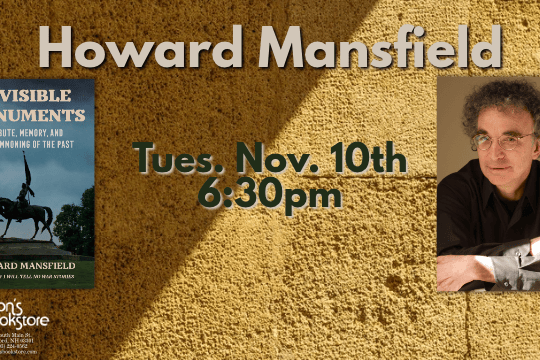
Howard Mansfield presents Invisible Monuments
Past event
Featured Book

Invisible monuments: tribute, memory, and the summoning of the past
"We don't look at most of the monuments and memorials around us. They disappear from view. Think of all the mute memorials you may pass in a week that are unseen, a blurred background to your daily commute: the green-mottled great man on his horse, hosting only pigeons; the curious obelisk looking like a stunted Washington Monument; the historical marker crowded with so many words it looks like a warning label written by a cadre of liability lawyers. So much narrative left out in the weather, so much storytelling that has lost its way. Any monument that we stand before asks something of us. Think of monuments as the first part of a call and response, as in music, as in worship. We bring our sense of history to the present, otherwise the granite/marble/limestone/bronze before us will be mute. A few monuments aren't invisible. They speak to us, like the Vietnam Veterans Memorial, and in another era, the Cenotaph in London that brought forth the strong emotional response after World War I. The goal with these stories is similar to the landscape painters: the author refreshes our sight so we look anew at the monuments around us, and so we can engage in a call and response with our history"-- Provided by publisher.
This book will be available for purchase at the event.
About This Event
Howard Mansfield returns to Gibson's Bookstore with his latest book, Invisible Monuments: Tribute, Memory, and the Summoning of the Past! ABOUT THE BOOKWe don’t look at most of the monuments and memorials around us. They disappear from view. Think of all the mute memorials you may pass in a week that are unseen, a blurred background to your daily commute: the green-mottled great man on his horse, hosting only pigeons; the curious obelisk looking like a stunted Washington Monument; the historical marker crowded with so many words it looks like a warning label written by a cadre of liability lawyers. So much narrative left out in the weather, so much storytelling that has lost its way. Any monument that we stand before asks something of us. Think of monuments as the first part of a call and response, as in music, as in worship. We bring our sense of history to the present, otherwise the granite/marble/limestone/bronze before us will be mute.A few monuments aren’t invisible. They speak to us, like the Vietnam Veterans Memorial, and in another era, the Cenotaph in London that brought forth the strong emotional response after World War I.Each chapter explores the invisibility of monuments: The forced invisibility of the African Burial Grounds in Manhattan and Portsmouth, New Hampshire, which have been rediscovered. These graveyards were destroyed in keeping with America’s “mortuary apartheid.”The sad fate of the Irish immigrants building America’s railroads in the nineteenth century, many killed on the job to be buried in unmarked graves.A grieving family’s memorial to a son lost in World War II, built stone by stone on the family’s farm, which still draws thousands to an outdoor “Cathedral of the Pines.”A Ferris wheel, stopped forever after a tragic accident, abandoned to rust, which becomes a private monument for a five-year-old boy.A celebrated, much-pictured monument for the Battle of Bunker Hill that doesn’t have the emotional charge and significance it once held.An unusual monument, a tribute to the future—a clock being built deep in a mountain, a clock that is meant to run for 10,000 years.And lastly, a monument hiding on museum walls. The great landscape painters of the nineteenth century, sometimes called the Hudson River School, weren’t out to just paint pretty pictures. They were chasing a moment of insight when they would see this new nation clearly. Their paintings taught Americans how to see wilderness and laid the bounds for many of our national parks. The goal with these stories is similar to the landscape painters: the author refreshes our sight so we look anew at the monuments around us, and so we can engage in a call and response with our history. ABOUT THE AUTHORHoward Mansfield sifts through the commonplace and the forgotten to discover stories that tell us about ourselves and our place in the world. He writes about history, architecture, and preservation. He is the author of a dozen books, including The Bones of the Earth, The Same Ax Twice, Chasing Eden, Dwelling in Possibility: Searching for the Soul of Shelter, and In the Memory House which The New York Times called “a wise and beautiful book.”In Mansfield’s most recent book, I Will Tell No War Stories: What Our Fathers Left Unsaid About World War II, he “breaks through the wall of silence some war veterans maintain,” said Booklist. “The result is an impeccably researched and beautifully written account of the stories his father wouldn’t tell. Readers will find themselves in heated sheepskin flight suits and oxygen masks, high in the sky over enemy territory…. A vital and moving history of all that is left unsaid in the aftermath of war and how that affects the next generation.”Mansfield has been honored by the N.H. Humanities Council as “a gem in our granite landscape” and this fall he will receive the Sarah Josepha Hale Award. He has won a Gold Medal for Commentary for City and Regional Magazines, a silver medal from the Independent Publisher Book Awards, and was a City and Regional Magazine Feature Story Finalist. He received an honorary Doctor of Humane Letters from Franklin Pierce University.He has served as a writer and consultant for museums, written and performed a stage show with composer Ben Cosgrove that was the subject of an Emmy Award-winning film, and has co-written a forthcoming documentary film.“Howard Mansfield has never written an uninteresting or dull sentence,” said the writer and critic Guy Davenport. “All of his books are emotionally and intellectually nourishing. He is something like a cultural psychologist along with being a first-class cultural historian.”
Featured Author
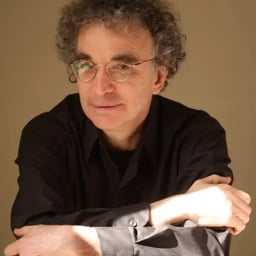
Mansfield, Howard
Howard Mansfield sifts through the commonplace and the forgotten to discover stories that tell us about ourselves and our place in the world. He writes about history, architecture, and preservation. He is the author of a dozen books, including The Bones of the Earth, The Same Ax Twice, Chasing Eden, Dwelling in Possibility: Searching for the Soul of Shelter, and In the Memory House which The New York Times called “a wise and beautiful book.” In Mansfield’s most recent book, I Will Tell No War Stories: What Our Fathers Left Unsaid About World War II, he “breaks through the wall of silence some war veterans maintain,” said Booklist. “The result is an impeccably researched and beautifully written account of the stories his father wouldn’t tell. Readers will find themselves in heated sheepskin flight suits and oxygen masks, high in the sky over enemy territory…. A vital and moving history of all that is left unsaid in the aftermath of war and how that affects the next generation.” Mansfield has been honored by the N.H. Humanities Council as “a gem in our granite landscape” and this fall he will receive the Sarah Josepha Hale Award. He has won a Gold Medal for Commentary for City and Regional Magazines, a silver medal from the Independent Publisher Book Awards, and was a City and Regional Magazine Feature Story Finalist. He received an honorary Doctor of Humane Letters from Franklin Pierce University. He has served as a writer and consultant for museums, written and performed a stage show with composer Ben Cosgrove that was the subject of an Emmy Award-winning film, and has co-written a forthcoming documentary film. “Howard Mansfield has never written an uninteresting or dull sentence,” said the writer and critic Guy Davenport. “All of his books are emotionally and intellectually nourishing. He is something like a cultural psychologist along with being a first-class cultural historian.”
About the Venue

More at Gibson's Bookstore
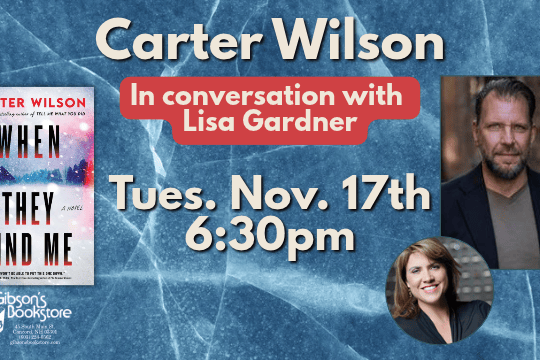
Carter Wilson presents When They Find Me
Thriller author Carter Wilson visits Gibson's Bookstore to share his latest novel, When They Find Me. Carter will be joined in conversation by fellow thriller author, Lisa Gardner. Some secrets don't fade. They hunt.Expanse, Colorado. Population 313. A town so remote it barely exists on a map—the perfect hiding place for Annie Wolfe and her daughter, Coral. Their cabin is nearly off the grid, and Annie has done everything to keep them safe. Everything. But she knows the people hunting her don't forget. And they don't forgive.Riven knows about survival. She and her family have lived off the land for years, moving like shadows through the wilderness. Now her father has led them to this forgotten town, tracking the man he swears destroyed their lives. The plan is simple: strike fast, take revenge, and disappear.But when Riven knocks on Annie's door, their worlds collide. What follows is darker, stranger, and more dangerous than either woman ever imagined—because the hunt isn't just for vengeance. It's for the truth. And in Expanse, Colorado, the truth can kill.Carter Wilson is the USA Today bestselling author of eight critically acclaimed, standalone psychological thrillers. He is an ITW Thriller Award finalist, a five-time winner of the Colorado Book Award, and his works have been optioned for television and film. Carter lives outside of Boulder, Colorado.Lisa Gardner, a #1 New York Times bestselling thriller novelist, began her career in food service, but after catching her hair on fire numerous times, she took the hint and focused on writing instead. A self-described research junkie, she has transformed her interest in police procedure and criminal minds into a streak of acclaimed novels. Her novel, The Neighbor, won Best Hardcover Novel from the International Thriller Writers. She has also been honored for her work with animal rescue and at-risk children. An avid hiker, gardener and cribbage player, Lisa lives with her family in New England.
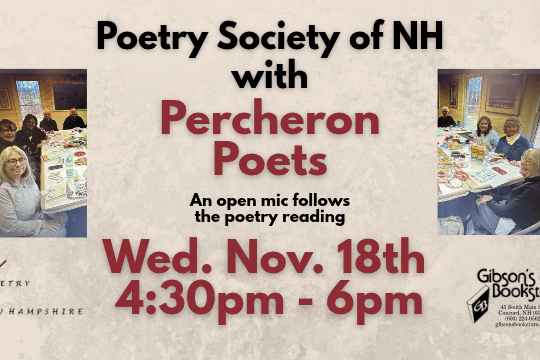
Poetry Society of New Hampshire: Percheron Poets
Join the Poetry Society of New Hampshire on Wednesday, November 18th, 2026, from 4:30-6:00pm for an afternoon of poetry! Their headliner this month is Percheron Poets. An open mic follows their readings.Percheron Poets are a community-based writing group of 10-12 women, based in central New Hampshire. The group started after participating for several years in poetry classes taught by and coordinated by poet Catherine O'Brian at the Twiggs Gallery in Boscawen. The Percheron Poets gather monthly at the Kimball-Jenkins Estate in Concord to share their work, host workshops and public readings, and help each other grow as writers. Poets come from Concord, Boscawen, Canterbury, Hollis, Penacook, Franklin Pittsfield and South Sutton. The name comes from the two Percheron horses in the field next to Twiggs Gallery, which was a welcoming and creative home for the poets.The group also takes on special projects such as a recent Ekphrastic Art & Poetry Exhibit, a popular annual Poetry & Pie event, master classes with New England poets, and a daylong Retreat at The Fells with time to write outdoors.Percheron Poets come together to support each other in creative ways, in listening, reading and making poems and art.
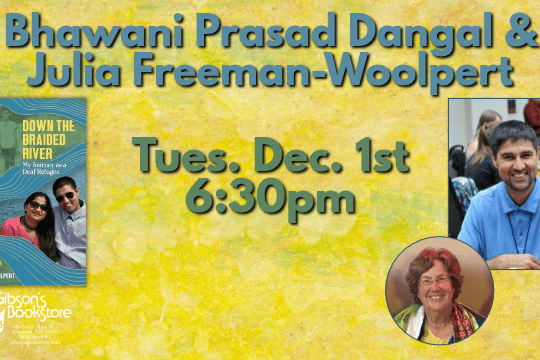
Down the Braided River with Bhawani Prasad Dangal & Julia Freeman-Woolpert
Join Bhawani Prasad Dangal & Julia Freeman-Woolpert as they present Down the Braided River: My Journey as a Deaf Refugee. Forced to flee with his family from Bhutan at seven, Bhawani lost his hearing shortly after -- and with it, language and connection. Across a refugee camp in Nepal and resettlement in New Hampshire, he built both back. Down the Braided River is a remarkable true story of survival, community, and belonging.Bhawani is a Deaf American citizen who arrived in the United States as a refugee from Bhutan in 2011. He is a deeply committed advocate and leader in the Deaf Bhutanese-American community, including working as a Nepali Sign Language to American Sign Language interpreter. He is a graduate of the prestigious Road to Deaf Interpreting program and has served in numerous educational and advocacy roles including serving on the Board of the Himalayan Foundation USA. He was a main organizer and keynote speaker at the first-ever World Deaf Refugee Day in 2021 and again in 2023. In 2015, he was featured as one of Concord TV’s “Most Fascinating Individuals.” He now lives in Pennsylvania and enjoys spending time with his wife and three sons.Julia lives in Concord, New Hampshire. She retired in 2018 from the New Hampshire Disability Rights Center where she spent her career advocating on behalf of people with disabilities. She holds a B.A. from Boston University and a M.Ed. from Antioch University. She has worked as a mentor and advocate for refugees for two decades, and with Deaf refugees since 2011. She has traveled throughout Nepal and India and spent a week in 2010 visiting the refugee camps in Nepal. In her spare time she loves to garden and travel the rest of the world.