
This event has passed
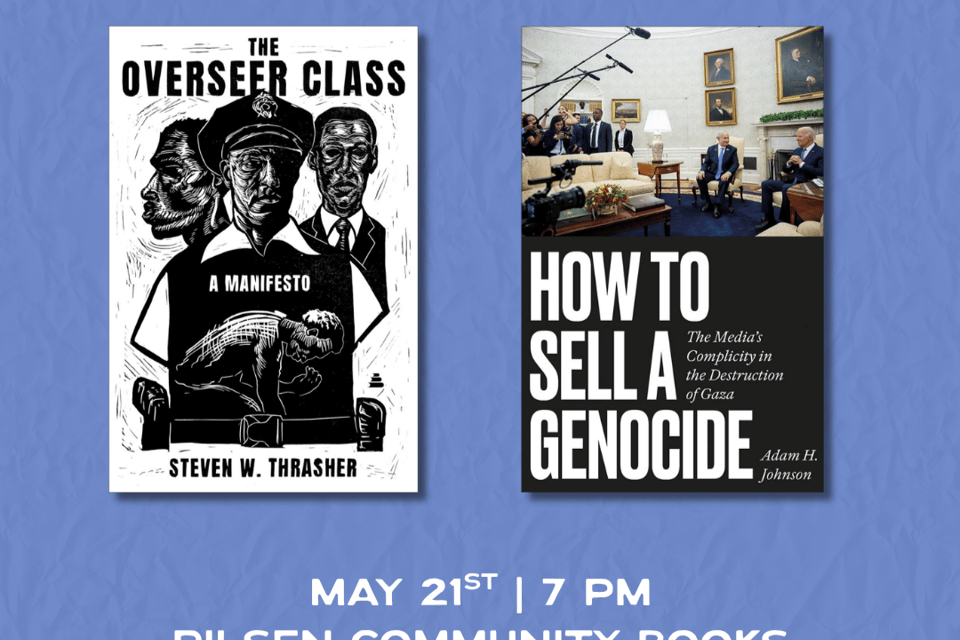
THE OVERSEER CLASS and HOW TO SELL A GENOCIDE with Steven W. Thrasher and Adam Johnson
Past event
Featured Book
The Overseer Class
The author of the critically acclaimed The Viral Underclass (one of Kirkus Reviews best books of 2022) is back with The Overseer Class, which explores what happens when members of historically minoritized groups are selected for high-visibility positions of power within existing institutions—but under the conditions of a kind of Faustian bargain.
This book will be available for purchase at the event.
About This Event
Join us as we welcome Steven W. Thrasher and Adam Johnson to the store for a conversation about Thrasher's The Overseer Class and Johnson's How to Sell a Genocide.
About The Overseer Class:
The author of the critically acclaimed The Viral Underclass (one of Kirkus Reviews best books of 2022) is back with The Overseer Class, which explores what happens when members of historically minoritized groups are selected for high-visibility positions of power within existing institutions—but under the conditions of a kind of Faustian bargain.
About How to Sell a Genocide:
As bombs rained down on Gaza in October 2023, images of mass death and destruction gripped the world, and openly genocidal statements from Israeli leaders foretold the magnitude of horrors to come. But the US media was quick to downplay, obscure, and repackage an emerging campaign of extermination into a slick “war on terror” framework.
Featured Author
Steven W. Thrasher, PhD
Steven W. Thrasher, PhD is the author of the award-winning book The Viral Underclass: The Human Toll When Inequality and Disease Collide, which was a New York Times's Paperback Row Editors' Pick, named one of the Best Nonfiction Books of 2022 by Kirkus Reviews, was longlisted for both the PEN/John Kenneth Galbraith Award for Nonfiction and the Carnegie Medal for Excellence in Nonfiction Literature, and won the 2023 POZ Award for Best in Literature. He is also the inaugural Daniel Renberg Chair for Social Justice in Reporting at the Medill School of Journalism and a faculty member of Northwestern University's Institute of Sexual and Gender Minority Health and Wellbeing. An internationally renowned scholar on race, gender, and infectious disease, Dr. Thrasher's writing has been published by the Guardian, Atlantic, New York Times, Scientific American, Literary Hub, and in many academic journals.
About the Venue

Pilsen Community Books
Pilsen Community Books is a worker owned and operated independent bookstore that specializes in new and used literary fiction, radical history and politics, and literature in translation. The staff's goal is to unite their bookselling experience with their belief that labor is entitled to all it produces.
Visit store pageMore at Pilsen Community Books

Lists and Letters: An Author Conversation with Marina Azahua and Karen Villeda
Join us at Pilsen Community Books for the closing event of the 2026 festival week — a reading and conversation with Marina Azahua and Karen Villeda, two of the most compelling voices in contemporary Mexican literature. Reading from Azahua’s novel Archivo agonía (Sexto Piso, 2025) and Villeda’s poetry collection String Theory , translated by NAFTA (Cardboard House Press, 2025), the authors will explore the intersections of storytelling and grief, and the forms that memory takes. The reading will be followed by a conversation with Lit & Luz Book Club host Angélica Julia Dávila and Mexican literature PhD student Alejandro Mendoza Díaz De León on the authors’ writing processes, the relationship between language, grief, and feminisms. Stick around afterward for a book signing with both authors! Presented in partnership with Pilsen Community Books. Acompáñanos en Pilsen Community Books para el evento de clausura de la semana del festival 2026: una lectura y una charla con Marina Azahua y Karen Villeda, dos de las voces más destacadas de la literatura mexicana contemporánea. A partir de la novela Archivo agonía de Azahua (Sexto Piso, 2025) y el libro de poesía Teoría de cuerdas de Villeda, traducido por NAFTA (Cardboard House Press, 2025), las autoras explorarán las intersecciones entre la narración y el duelo, así como las formas que adopta la memoria. Tras la lectura, seguirá una conversación con Angélica Julia Dávila, presentadora del club de lectura Lit & Luz, y Alejandro Mendoza Díaz De León, estudiante de doctorado en literatura, sobre los procesos de escritura de las autoras, la relación entre el lenguaje, el duelo y los feminismos. ¡Quédate para la sesión de firma de libros con ambas autoras! Presentado en colaboración con Pilsen Community Books.
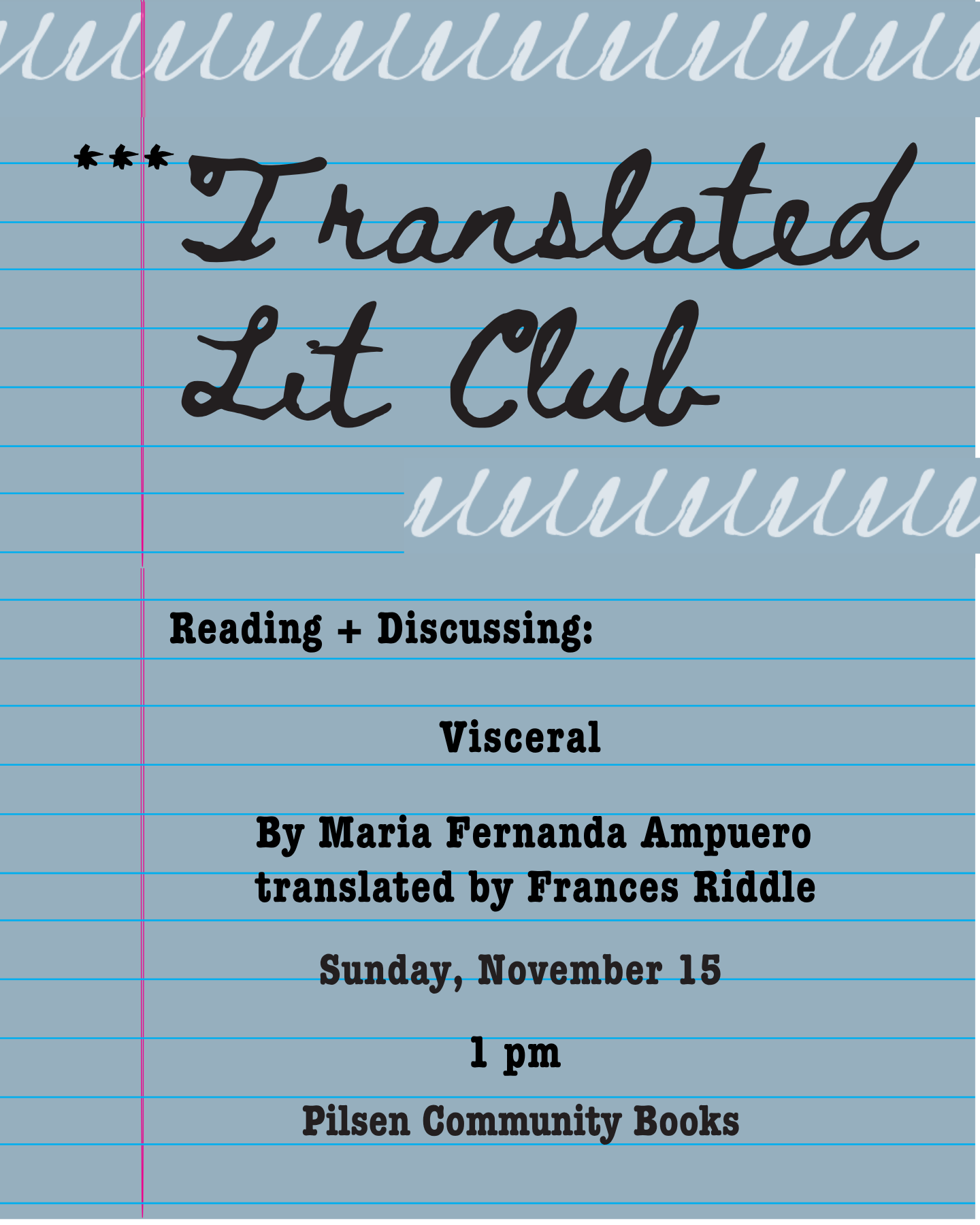
Translated Lit Book Club: Visceral
💫Attention all literature in translation fans!💫 The newly relaunched Translated Lit Club will meet on November 15 at 1 pm. We will be discussing Maria Fernanda Ampuero's Visceral , translated by Frances Riddle. All are welcome! About Visceral: What does it mean to move with a woman’s body through a misogynistic world? María Fernanda Ampuero, one of the greatest writers of the new wave of Latin American gothic fiction, answers this question in this personal essay collection that’s part analysis, part confessional, and part horror story. Through vivid personal details—finding a corpse in the shade of a colorful parasol during the pandemic, remembering a disintegrating relationship through a letter to a stuffed mouse, slowly realizing she is being abducted by a Tinder hookup, imagining herself a barbarian on the streets of Madrid—and with surreal dark humor, Ampuero traces her memories of colonizers and exiles, parents and childlessness, lockdown relationships and lost innocence, fatphobia, mental illness, and writing as a practice for surviving all of it. What emerges is one woman’s account of what it means to live in a human body—oppressed, ailing, and outraged—told as only Ampuero can.
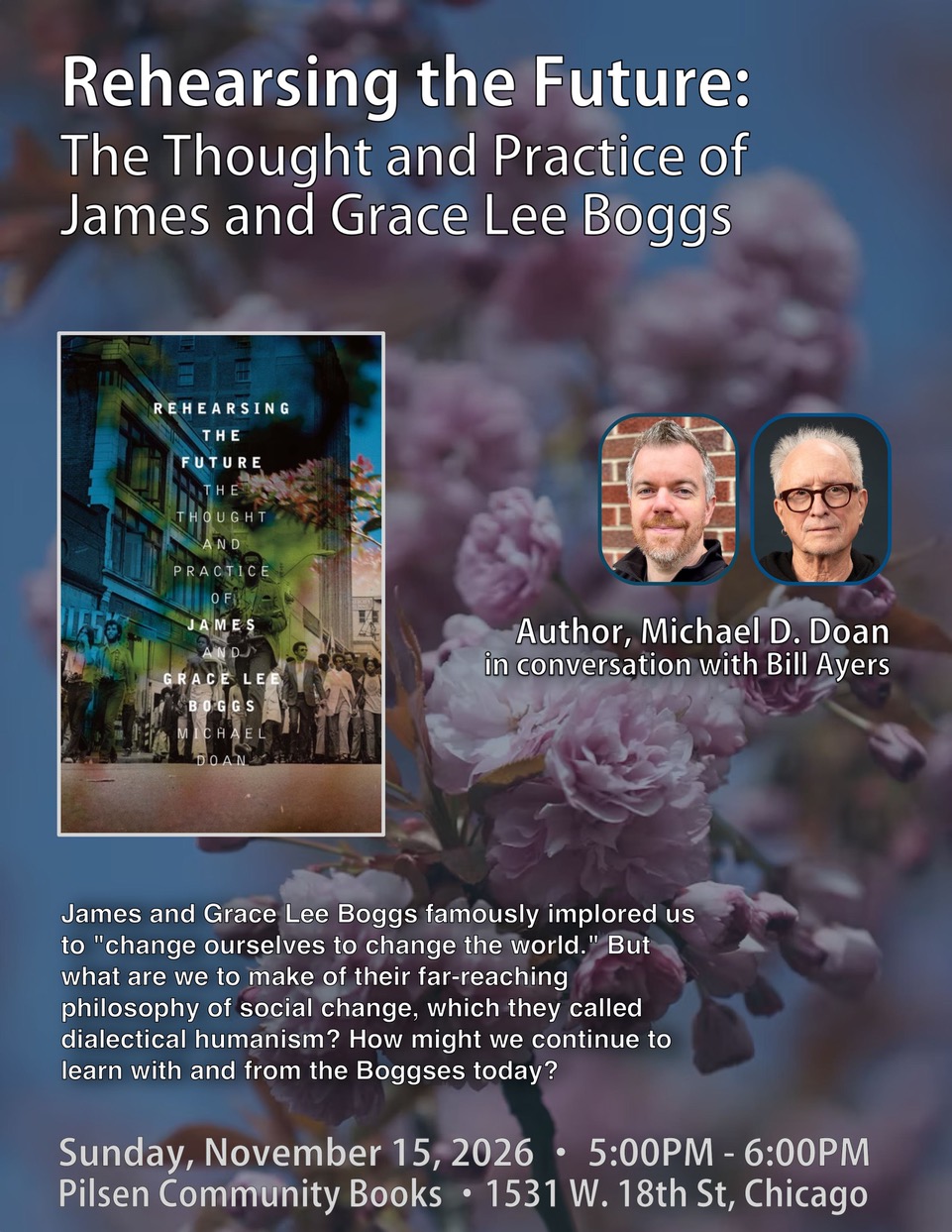
Rehearsing the Future: The Thought and Practice of James and Grace Lee Boggs with Michael D. Doan and Bill Ayers
James and Grace Lee Boggs famously implored us to "change ourselves to change the world." But what are we to make of their far-reaching philosophy of social change, which they called dialectical humanism? How might we continue to learn with and from the Boggses today? Join us as we join Under the Tree Podcast to celebrate the release of Michael Doan's new book, Rehearsing the Future: The Thought and Practice of James and Grace Lee Boggs . The discussion will be facilitated by Bill Ayers, renowned activist, engaged scholar, and author of numerous books on social justice and education. Rehearsing the Future explores the work and legacy of James and Grace Lee Boggs, two of the most influential American radical thinkers of the twentieth century. Grace Lee Boggs earned a PhD in philosophy in the 1940s, though facing obstacles to an academic career as a young Chinese American woman, she left and became a political organizer in Detroit, where she met and married James Boggs, a Black autoworker and labor organizer from Alabama who had moved North during the Great Migration. Over the course of more than forty years of partnership and participation in labor, civil rights, Black Power, anticolonial, and feminist movements, the Boggses articulated a philosophy of long-term revolutionary strategy they called “dialectical humanism.” Rejecting state socialism and traditional Marxism, dialectical humanism instead attributes social change to the conscious, collective activity of people engaged in place-based organizing with a view to transforming everyday life, with hallmark projects such as community gardens, daycare networks, and mediation programs. Above all, revolution is not a fixed program but must evolve as ideas, movements, and institutions are changed through collective practice. Through their life work and publications, James and Grace Lee Boggs modeled how to do philosophy from within movements. In Rehearsing the Future , Michael Doan lays out the intellectual history of dialectical humanism, the far-reaching theory and practice that continues to guide movement-building around the world, inspiring forms of activism such as visionary organizing and emergent strategy. This book is for scholars and activists interested in the theoretical underpinnings of today's community movements. Michael D. Doan is a Canadian-born father, educator, activist, and philosopher. He joined the James and Grace Lee Boggs Center to Nurture Community Leadership in 2016 and is an Associate Professor of Philosophy at Oakland University.